



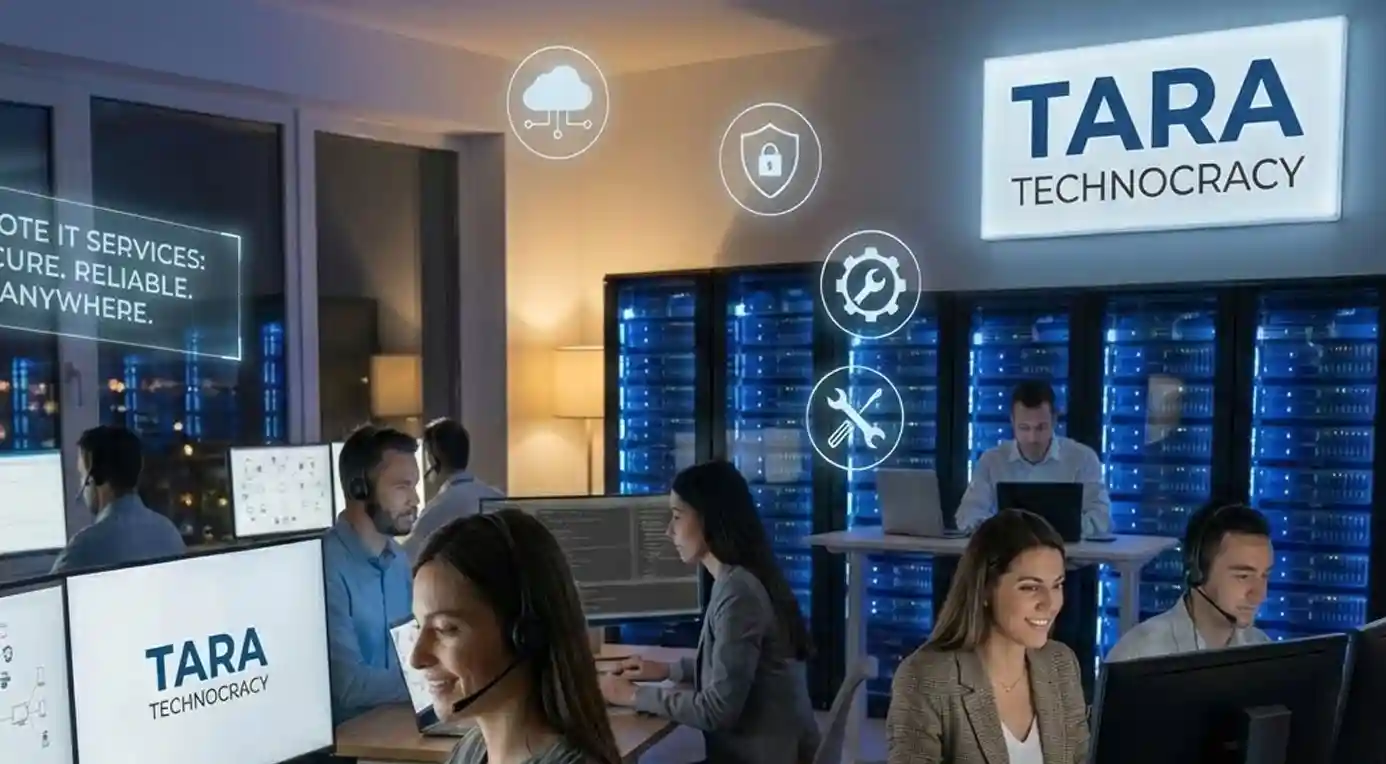
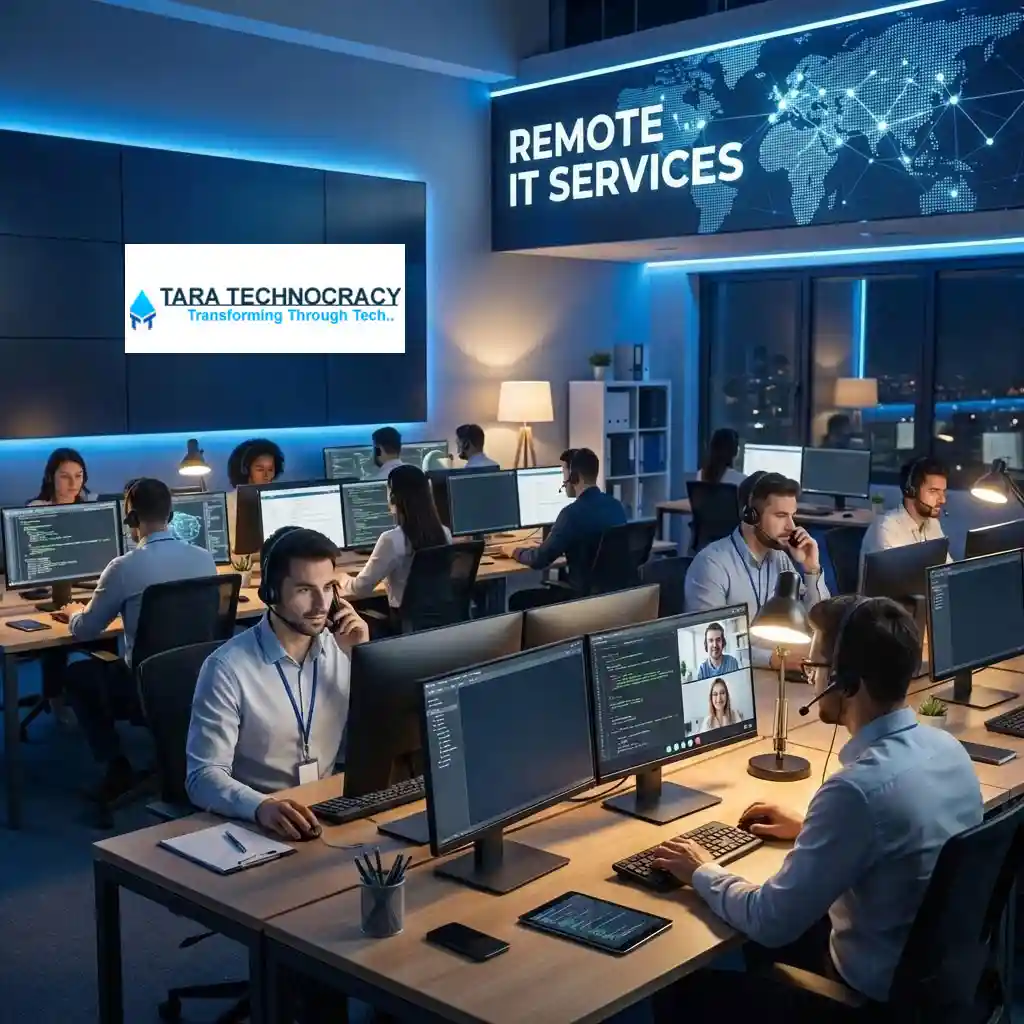
Remote IT Services & Support encompass a range of technology support solutions that are delivered over the internet. Our 24×7 services are designed to help businesses manage their IT infrastructure efficiently without the need for on-site visits. Key offerings often include:
Remote IT Support & Services
- Remote Monitoring and Management (RMM): Continuous monitoring of systems and networks to detect and resolve issues proactively.
- Help Desk Support: Providing users with assistance for technical issues via chat, email, or phone. This can include troubleshooting software, hardware, or network problems.
- Data Backup and Recovery: Ensuring that data is regularly backed up and can be restored in case of loss due to hardware failure, cyberattacks, or other incidents.
- Cybersecurity Services: Implementing and managing security measures, including firewalls, antivirus solutions, and intrusion detection systems.
- Cloud Services: Supporting cloud infrastructure, including setup, management, and migration of data and applications to cloud platforms.
- Software as a Service (SaaS): Offering access to software applications via the cloud, often with ongoing support and updates.
- IT Consulting: Providing strategic advice on IT planning, infrastructure improvements, and technology investments.
- Network Setup and Management: Assisting with the setup and maintenance of local and wide-area networks, including Wi-Fi solutions.
Frequently Asked Questions: Remote IT Services
1. What exactly do your Remote IT Services cover?
Our remote IT support acts as your virtual IT department. The scope includes:
-
Cloud Infrastructure Management: Administering Google Workspace, Microsoft 365, and Zoho environments.
-
Helpdesk Support: Troubleshooting day-to-day employee issues (email glitches, software crashes, password resets).
-
Security & Compliance: Managing endpoint security, antivirus deployment, and remote data wipes for lost devices.
-
Employee Onboarding/Offboarding: Provisioning accounts and configuring software for new hires, and securely revoking access when employees leave.
2. How fast is namaSTu.com’s response time during an IT emergency?
We operate on strict Service Level Agreements (SLAs).
-
Critical Issues (e.g., Server down, company-wide email outage): Immediate response and escalation.
-
Standard Requests (e.g., Software installation, printer setup): Addressed within a defined timeframe based on your specific support tier.
You can reach our helpdesk via our dedicated support portal, email, or a direct phone call to our response team.
3. Is it safe to grant you remote access to our company computers for remote IT services?
Security is our primary focus. We use enterprise-grade, encrypted remote monitoring and management (RMM) tools.
-
Consent-Based Access: For desktop support, our technicians require the user’s explicit permission to take over the screen.
-
Audit Trails: Every remote session is logged and tracked.
-
Confidentiality: As an initiative of TARA TECHNOCRACY, we sign comprehensive Non-Disclosure Agreements (NDAs) to legally protect your proprietary data.
4. Why should we outsource to namastu.com instead of hiring an in-house IT person?
Hiring a full-time, experienced IT professional involves high salaries, benefits, and training costs.
By partnering with us, you gain access to an entire team of certified experts for a fraction of the cost of a single employee. Furthermore, a single IT person takes vacations and sick days; our remote IT helpdesk provides continuous, uninterrupted coverage.
5. Can you manage our remote and hybrid workforce?
Yes. Managing distributed teams is our speciality. We implement Mobile Device Management (MDM) and centralised cloud policies to ensure that your employees’ laptops and mobile phones remain secure and compliant with company policy, regardless of whether they are working from an office in Mumbai or a cafe in Bangalore.
6. Do we need to use Google Workspace to use your remote IT services?
No. While we are a Premier Google Workspace Reseller, our remote IT engineers are platform-agnostic. We provide comprehensive support for Microsoft 365 environments, Zoho Workplace, custom web hosting setups, and legacy systems.
Q6: How do you handle patch management and endpoint monitoring without disrupting our hybrid workforce?
A: We deploy lightweight, silent Remote Monitoring and Management (RMM) agents on all corporate endpoints.
-
Telemetry & Automation: The RMM agent feeds real-time telemetry (CPU usage, disk health, software inventory) to our central dashboard.
-
Silent Patching: We schedule OS updates and third-party software patching (via scripts and MSI/PKG deployments) during off-hours or maintenance windows, ensuring zero disruption to the end-user’s workday.
Q7: Can you manage a hybrid directory environment, such as syncing our On-Premises Active Directory (AD) with Google Workspace or Microsoft 365?
A: Yes. We specialise in hybrid Identity and Access Management (IAM).
-
Directory Syncing: We utilise tools like Google Cloud Directory Sync (GCDS) or Microsoft Entra Connect to establish a one-way sync from your LDAP/Active Directory to the cloud.
-
Single Sign-On (SSO): We configure SAML 2.0 and OAuth protocols so your users can access all approved SaaS applications using a single set of secure, centrally managed credentials.
Q8: We want to move away from legacy VPNs. Do you support Zero Trust Network Access (ZTNA)?
A: Absolutely. Legacy VPNs create a vulnerable perimeter. We implement Zero Trust architectures where access is granted based on identity and context, not network location.
-
Context-Aware Access: We configure policies in Google Workspace or Entra ID that evaluate the user’s IP location, device security posture (e.g., is disk encryption enabled?), and time of day before granting access to specific corporate apps.
Q9: What is your protocol for ransomware containment on a remote employee’s endpoint?
A: Our incident response protocol is designed for immediate isolation and remediation.
-
Network Isolation: The moment our Endpoint Detection and Response (EDR) tools detect anomalous encryption behaviour, the RMM agent automatically severs the device’s network connection, preventing lateral movement across your network.
-
Remediation: We then initiate a remote wipe (if necessary) and restore the user’s data from immutable cloud backups, minimising downtime.
Q10: How do you enforce corporate policies on BYOD (Bring Your Own Device) mobile phones without violating employee privacy?
A: We utilise strict Mobile Device Management (MDM) containerization to separate work and personal data.
-
Work Profiles: Using Android Enterprise and Apple User Enrollment, we create an encrypted “Work Profile” on the employee’s personal device.
-
Data Control: Our IT admins can enforce passcodes, block copy/pasting between work and personal apps, and remotely wipe the corporate container if the employee leaves, all without having any access to their personal photos, texts, or browsing history.
Q11: How do you ensure our data remains compliant with local Indian regulations (like the DPDP Act) during remote support sessions?
A: As an Indian entity (TARA TECHNOCRACY), we strictly adhere to local compliance frameworks.
-
Audit Logging: Every remote desktop session initiated by our engineers generates a secure, unalterable audit log and video recording (if requested) for your compliance officer.
-
Principle of Least Privilege: Our support engineers operate using Just-In-Time (JIT) access and role-based access control (RBAC). They only receive the administrative privileges necessary to fix a specific ticket, which expire immediately after the ticket is closed.
By leveraging remote IT Services, organisations can reduce costs, improve efficiency, and ensure that they have access to expert support whenever needed. If you have specific questions or need more details on a particular service, feel free to ask –info@namastu.com