




Still confused about Free Email vs Business Email. When starting a business or side hustle, it is tempting to take the path of least resistance: sign up for a free Gmail or Yahoo account and start sending messages. It’s free, familiar, and easy. We at namaSTu.com help you with business email.
However, as a business grows, the distinction between a “free” inbox and a “business” inbox becomes the difference between a hobby and a professional enterprise. The real difference isn’t just the price tag—it comes down to ownership, security, and how the world perceives your brand.
Here is a deep dive into the real differences between free email and professional business email.
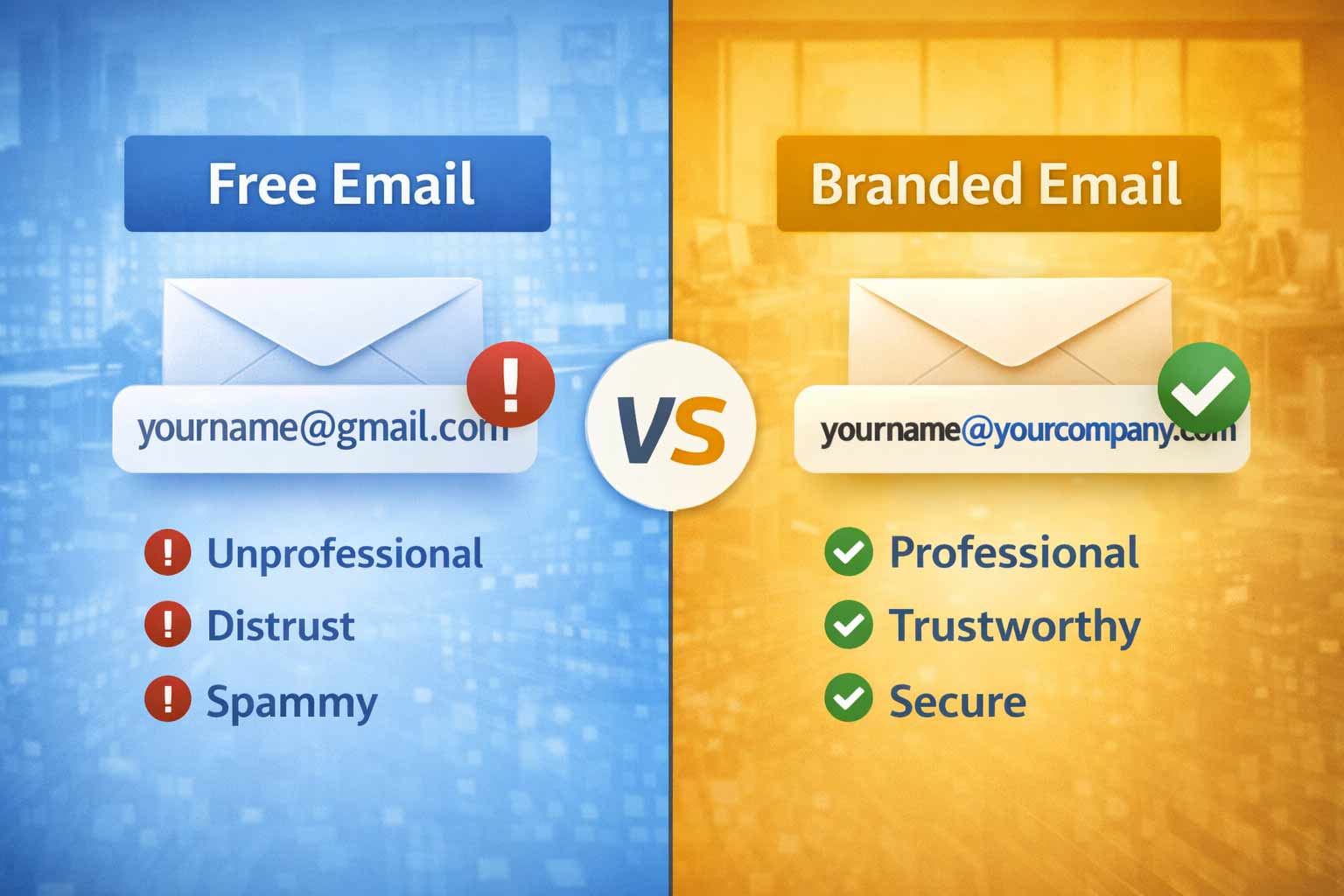
1. The “First Impression”- Free Email vs Business Email
The most immediate difference is visible to everyone you email: the domain name.
-
Free Email (
@gmail.com,@yahoo.com): Using a generic domain signals that you are an individual user. While acceptable for freelancers just starting, it can inadvertently signal to clients that your business is temporary, part-time, or lacks resources. -
Business Email (
@yourcompany.com): A custom domain acts as a digital business card. It verifies your identity and instantly builds credibility. It tells the recipient, “I am established enough to invest in my own infrastructure.”
The 3-Second Rule: Studies show you have about 3 seconds to establish trust in a cold email. A custom domain passes this test instantly; a free domain often raises a red flag.
2. Who Owns the Data? In Free Email vs Business Email.
This is the most overlooked operational risk in using free email for business.
-
Free Email: The account belongs to the individual who created it. If you hire an employee and let them use it
john.sales1@gmail.comfor work, they own that account. If they leave the company, they take the login credentials, the client conversations, and the contact lists with them. You have no legal recourse to recover that data. -
Business Email: The account belongs to the organisation. As the administrator, you control the access. If an employee leaves, you can instantly reset their password, lock them out, and transfer their email history to another team member. Your business data stays with the business.
3. Security and Admin Control
Cybersecurity threats are evolving, and businesses are primary targets.
-
Free Email: Security is standardised. You rely on the provider’s general spam filters. You cannot force users to use 2-Factor Authentication (2FA) or track suspicious login activity.
-
Business Email: You gain “Super Admin” powers. You can:
-
Enforce 2FA for all employees to prevent hacking.
-
Remote Wipe devices if a company laptop or phone is lost or stolen.
-
Set Data Retention Policies (e.g., prevent employees from auto-forwarding company emails to private accounts).
-
4. Deliverability: Avoiding the Spam Folder
Have you ever sent a client an invoice that “went to spam”?
-
Free Email: Spammers frequently use free accounts to send junk mail. Because of this, aggressive firewalls at large corporations often flag emails from free providers as “low trust,” sending your legitimate business proposal straight to the Junk folder.
-
Business Email: Professional email hosting allows you to authenticate your domain (using protocols like SPF and DKIM). This verifies to the recipient’s server that you are a legitimate sender, drastically increasing the chances your email lands in the Primary Inbox.
Summary: The Feature Breakdown
| Feature | Free Email (Personal) | Business Email (Professional) |
| Domain | Generic (@gmail.com) |
Custom (@yourbrand.com) |
| Storage | Limited (usually 15GB shared) | Scalable (30GB to Unlimited) |
| Tech Support | Community Forums / FAQs | Dedicated Phone/Chat Support |
| Advertising | Ads are often shown in the interface | Ad-free workspace |
| User Management | None (Single User) | Centralized Admin Console |
The Verdict
Is free email ever okay? Yes—for personal use, casual blogging, or very early-stage solo experiments.
However, if you are exchanging sensitive data, invoicing clients, or building a brand reputation, Business Email is not an optional expense; it is a foundational tool. The cost is minimal (often the price of a coffee per month), but the payoff in trust, security, and asset protection is massive.