




In the early stages of a startup, using a free Gmail account (e.g., companyname@gmail.com) feels like a smart, frugal decision. It’s free, familiar, and easy to set up for business email security.
However, as we move through 2026, the digital landscape has shifted. “Free” email is no longer just a branding faux pas; it is a significant operational liability. Recent cybersecurity statistics and legal precedents have turned personal email accounts into a ticking time bomb for growing businesses.
Here is a detailed breakdown of the real business risks involved in using free email versus a professional domain.
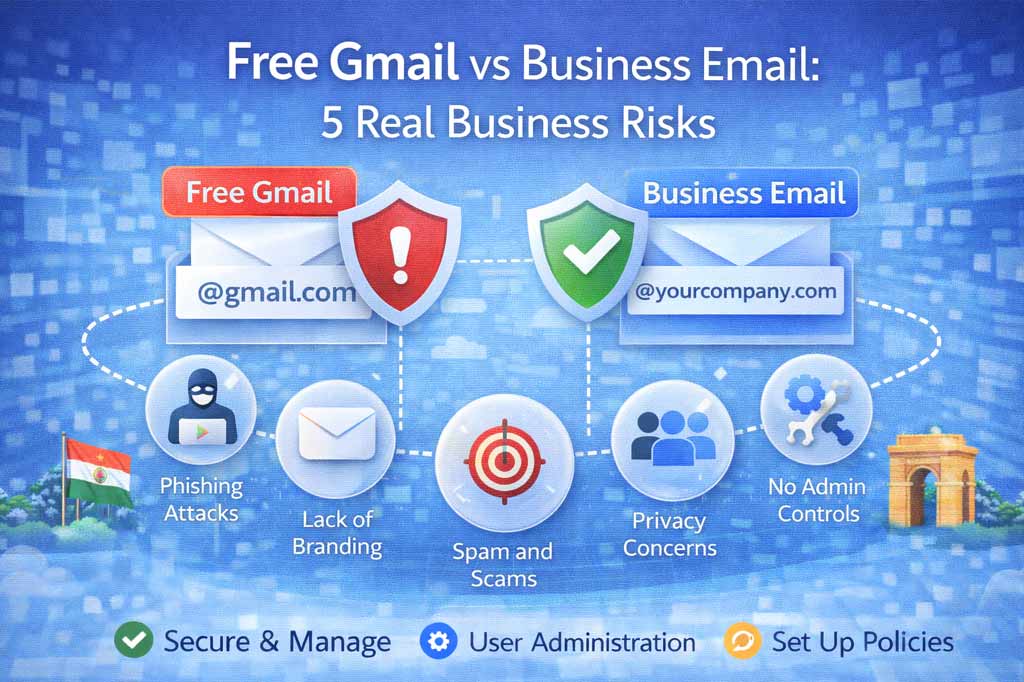
1. The Legal Nightmare: You Don’t Own Your Data
The most critical risk is Data Ownership.
-
Free Email: According to the Terms of Service of most free providers, the account belongs to the individual who registered it, not the company.
-
The Risk: If an employee uses
john.sales.company@gmail.comand leaves the company on bad terms, they legally own that account. They can refuse to hand over the password, effectively stealing your client list, active leads, and proprietary data. In recent 2024-2025 court cases, businesses have struggled to legally force former employees to surrender personal accounts used for work.
-
-
Business Email: The account (e.g.,
john@yourcompany.com) is owned by the organization. You have “Super Admin” rights, meaning you can reset the password, lock the employee out, and transfer their data to a new hire instantly upon termination.
2. The 2026 Deliverability Crisis
In February 2024, Google and Yahoo implemented strict new sender requirements that have only tightened in 2026.
-
The Risk: To prevent spam, major email providers now require advanced authentication protocols (SPF, DKIM, and DMARC). You cannot set these up on a free Gmail account. More information on SPF, DKIM, and DMARC) from namaSTu.
Note : Set up SPF, DKIM, and DMARC for domain -
The Consequence: Emails sent from free accounts to business clients are increasingly being flagged as “Suspicious” or blocked entirely. If you are using free email, your invoices and proposals are likely landing in the Spam folder, directly impacting your revenue.
3. Security & Phishing Vulnerabilities
Small businesses are the target of 43% of all cyber attacks, and free email is the easiest entry point.
-
Spoofing: It is incredibly easy for a hacker to create
ceo.yourcompany@gmail.comand trick your finance team into paying a fake invoice. -
No Admin Control: On free email, you cannot enforce security policies. You cannot force your employees to use 2-Factor Authentication (2FA), nor can you remotely wipe company data from their phone if it gets stolen.
-
The Cost: The average cost of a data breach for a small business in 2025 was estimated between $120,000 and $1.24 million. Professional email hosting (like Google Workspace) includes enterprise-grade security features that block 99.9% of these attacks.
4. Compliance Failures (GDPR, HIPAA, SOC2)
If your business handles any sensitive data—customer names, addresses, or health info—using free email is likely a violation of privacy laws.
-
HIPAA & GDPR: Free consumer Gmail is not HIPAA compliant out of the box. Google will not sign a Business Associate Agreement (BAA) for a free account.
-
The Fine: Using free email to send patient or sensitive client data can result in massive regulatory fines, regardless of whether a hack occurs.
5. The “Hobbyist” Perception
Perception is reality in business.
-
Trust Deficit: Research shows that customers are 9x more likely to choose a business with a professional email address over one using a free ISP account.
-
Brand Erasure: Every time you send an email from
@gmail.com, you are promoting Google’s brand, not yours. A professional email reinforces your website name with every message sent, acting as a constant, free marketing tool.
Comparison Table for Business Email Security
Free Gmail vs Google Workspace or Business Email
| Feature | Free Gmail (Personal) | Business Email (Google Workspace) |
| Data Ownership | The Individual User | The Business Entity |
| Custom Domain | No (@gmail.com) |
Yes (@yourcompany.com) |
| Admin Control | None | Full Centralised Control |
| 24/7 Support | No (Community Forums only) | Yes (Phone/Chat/Email) |
| Storage | 15 GB (Shared with Photos) | 30 GB to Unlimited |
| Security | Basic Standard Filters | Advanced Phishing & Endpoint Protection |
How Google Workspace Helps in Business Email Security?
To understand the real-world impact, let’s compare two consulting firms competing for the same high-value contract.
Company A: TARA TECHNOCRACY
-
Tagline: “Transforming Through Tech”
-
Email Setup: Free Gmail (
taratechnocracy@gmail.com) -
The Vibe: A scrappy, hard-working consulting firm that hasn’t invested in IT infrastructure yet.
Company B: namaSTu.com
-
Brand Ambassador: Nia
-
Email Setup: Professional Business Email (
info@namastu.com) -
The Vibe: An established, secure, and brand-conscious enterprise.
Scenario 1: The $50,000 Proposal (The Trust Test)
Both companies send a cold email proposal to a Fortune 500 client.
-
❌ TARA TECHNOCRACY Experience:
-
The Inbox View: The client’s phone notification reads: New Email from taratechnocracy.consulting@gmail.com.
-
The Reaction: The client hesitates. “Is this a real company? Or just a freelancer working from a basement?” The generic domain dilutes the power of their tagline, “Transforming Through Tech.” It feels risky.
-
The Result: The email is flagged by the client’s corporate firewall as “Unverified Sender” and lands quietly in the Spam Folder. The proposal is never seen.
-
-
✅ namaSTu.com Experience:
-
The Inbox View: The notification reads: New Email from Nia | namastu.com.
-
The Reaction: The client instantly recognizes the domain name. It matches the website they visited earlier. The custom domain signals, “We are an established entity with our own infrastructure.”
-
The Result: Because
namastu.comhas authenticated its email (SPF/DKIM), the message lands directly in the Primary Inbox. The client opens it, trusting the source.
-
Scenario 2: The “Rogue Employee” Nightmare (The Data Risk)
Both companies hire a sales manager named Rahul. After one year, Rahul leaves to join a competitor.
-
❌ TARA TECHNOCRACY’S Crisis:
-
The Setup: Rahul was used
rahul.tara.tech@gmail.comto managing all client conversations. -
The Exit: When Rahul quits, he refuses to hand over the password. “It’s my personal Gmail account,” he argues.
-
The Loss: TARA TECHNOCRACY loses access to one year of client history, contracts, and leads. Rahul takes that data with him to the competitor. The company is legally helpless.
-
-
✅ namaSTu.com for business email security:
-
The Setup: Rahul was using
rahul@namastu.com, a business account owned by the company. -
The Exit: The moment Rahul resigns, the IT Admin logs into the Google Workspace Admin Console.
-
The Fix: With one click, they reset Rahul’s password and sign him out of all devices. The company retains 100% of the data. The new sales manager takes over the inbox the next morning without missing a beat.
-
What We Conclude
TARA TECHNOCRACY saved INR 130/month on email hosting but lost a $50,000 contract and their entire client database.
Focus Keywords: Free Gmail vs business email, risks of using personal email for business, business email security 2026, data ownership laws email, small business cybersecurity statistics.
namaSTu.com paid for professional hosting and gained a secure asset that grows with their brand.
The cost of professional email hosting is roughly the price of a single coffee per month. In contrast, the cost of a lost client, a data breach, or a legal battle over account ownership can devastate a business.
In 2026, professional email is not an “upgrade”—it is the baseline requirement for running a secure, legitimate business.
Need Help?
namaSTu.com helps Indian businesses with:
- Choosing the best Google Workspace plan for small business
- Google Workspace setup
- Google Workspace Outlook Setup
- Google Workspace Buying
- Secure Role & Access design
- User migration and training
- GoDaddy to Google Workspace Migration
- Rediff Pro to Google Workspace Migration
- cPanel To Google Workspace Migration
- ZOHO Email to Google Workspace Migration
namaSTu.com is an authorized Google Workspace partner in India, specialising in business email solutions, Google Workspace migration, admin setup, and security management. The team helps startups, SMEs, schools, and enterprises adopt professional email, cloud collaboration, and secure digital workspaces. With a focus on zero-data-loss migration, compliance-ready billing, and local support, namaSTu.com enables businesses to scale efficiently using Google Workspace.
Contact us for a free Google Workspace admin audit.